top of page

Fluency with Frog and Toad
Rationale:
Students need to eventually become fluent readers. In Making Sight Words, fluency is defined as “reading with automatic word recognition.” Along with reading the texts smoothly, students also need to be able to comprehend the story. Students can become more fluent by rereading, decoding, crosschecking, and mental marking. In this lesson, students will use these skills while reading “Frog and Toad Are Friends.”
Materials:
-
Full or half class set of stopwatches
-
Class set of “Frog and Toad Are Friends”
-
Fluency checklist for whole class
-
Cover up critters
-
Pencils
-
Ruled index cards (for comprehension questions)
-
Frog Fluency chart
Procedures:
-
“Today we are going to learn about fluency. Fluency means you can read words quickly because you already know what the word is by just looking at it. For example, is and should be sight words that you know because you see those words everywhere. By decoding, rereading, crosschecking, and mental marking, we can build our sight words and become faster and smoother readers. Part of fluency is knowing what you just read, so we cannot read too fast, or it doesn’t do any good for us.”
-
“I’m going to say a sentence and show you how someone can build their fluency. My dad p-parked his car in the garage (garage pronounced as /garag/) hmmm…. /garaj/. My dad parked his car in the garage. And now since I know all the words in this sentence, I can read it faster. Let’s do one more sentence: John pl-ayed the gutter…hmm..guitar. John played the guitar.”
-
“Now I want you to get “Frog and Toad.” Frog and Toad are friends, and Frog is ready to play outside, but Toad has something else he would rather do instead. Now I want you to read silently and see what Toad likes to do. I do not want to hear you whisper reading. There is not going to be a time limit, but if you go too slow then you might forget what you are reading about, but also don’t go too fast where you can’t understand what is happening in the story. If you finish before the rest of our friends, do not be disruptive because they are trying to learn, you can put your head down until everyone is ready. You can have a cover critter if you would like one, but they are only here to help you with difficult words.”
-
After students are done with their silent reading pass out an assessment paper and fluency checklist to each student. “Now I have given you two pieces of paper with different assessments on it. I am going to spilt everyone up into pairs.” If there is an odd number, the teacher may pair up with a student. “One person from each pair is going to get a stopwatch. When you time your partner, make sure you start it when they read the first word of the book and stop it when they finish it. We want to make sure they get a correct score when I calculate it later.” Give each student an index card.
-
“In your pairs, you are going to read the book two more times out loud to your partner. While the reader is reading, the partner is only timing. After the reader is done, the other partner will fill out the boxes under the first column if it applies. Then, the partner who was timing will be the reader. You will do that one more time but after the reader reads the second time, the partner who timed will fill out the boxes that apply under the second column.
-
On the index card I gave you, the side with the lines is going to be for the comprehension questions I will ask later; on the blank side, I want you to write time 1 and time 2. This is where you will record your partner's time. So be sure to put your name then put partner and then your partner’s name.”
-
After students are done reading write the comprehension questions on the board. “Now that everyone is done, I want you to answer these questions alone. When you have answered the questions, I want you to bring the fluency checklist and index card to me and make sure both your name and your partner's names are on there and that they are correctly labeled.” Calculate the WPM for each student and also average them together.
-
“For the last part of this lesson, I am going to call you up one by one and have you read “Frog and Toad” to me. Just like you did with your partner, I am going to see how long it takes you to read it to see if you have gotten faster from when you read with your partner. If you are not reading to me, you can draw/write in your journal or pick a different book to read until it is your turn.”
-
After students have all read to the teacher individually, “I have calculated how many words per minute everyone read, but this number I am about to put on the board is how many we average as a class. This number is not your individual number but our class number.” Plot number and move frog to new WPM.
Activities:
Comprehension Questions:
-
How many characters were there in the story?
-
Who did not want to get out of bed?
-
What made that character get out of bed?
Class WPM Chart
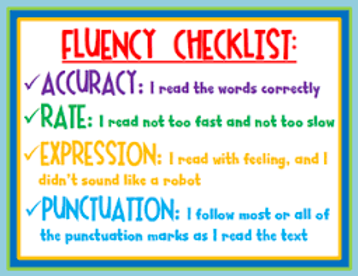
Fluency Checklist (from Making Sight Words)
Index Card sample:
Your name: _____
Your partner’s name: ______
Time 1: __________
Time 2: _________


References:
Lobel, Arnold. Frog and Toad are Friends. HarperCollins, 2003
McGill, Molly. “Growing Independence and Fluency Design.” Growing Independency and Fluency Design, 2021, https://mrm0130.wixsite.com/my- site-1/growing-independence-anf-fluency-design.Murray, Bruce. Making Sight Words. Linus Publications, Inc., 2012. Print.
Contact: alp0095@auburn.edu
Invitations Homepage:
https://wp.auburn.edu/rdggenie/home/classroom/invitations/


bottom of page